It is not possible to appreciate the sculptural and luminous quality of Rob's work in two dimensions, such as on this website page or in an exhibition catalogue. It is highly recommended that you view the work in person.


Early Works
Mike Oldfield - Hibernaculum, 1994
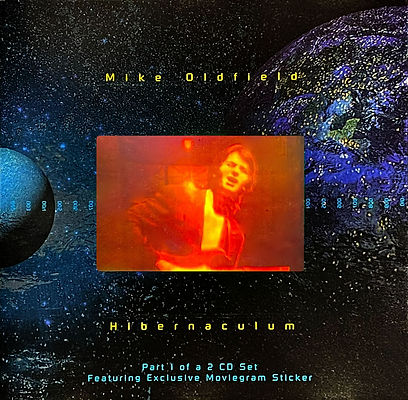
In 1994, I was commissioned to design and produce the world’s first digitally generated, full‑colour, animated CD album cover hologram for the British multi‑instrumentalist and composer Mike Oldfield, best known for his landmark 1973 album Tubular Bells, which launched Virgin Records.
The commission came from Altered Images Ltd., the company behind the celebrated Magic Eye random‑dot stereograms that captivated audiences worldwide.
The video for the single was provided by them, and I selected a suitable two-second sequence. To realise the hologram, I then employed my proprietary DI‑HO (Digital Input – Holographic Output) system, which I had conceived of and built between 1989 and 1991, to create a full-colour and animated holographic stereogram. I named this unique type of hologram, a 'Moviegram'.
This pioneering technology was the world’s first computer‑automated 3D 'digital' holographic stereogram recording system, enabling the seamless translation of digital imagery into holographic form.
Queen - The Ultimate Collection, 1995


In 1995, I was commissioned to create a digitally produced, full colour, animated hologram, which I had christened a 'Moviegram' after creating the above hologram for Mike Oldfield, for the band Queen. The hologram was commissioned by IC Holographic, a London based hologram design and marketing agency.
The hologram adorned Queen – The Ultimate Collection, a 26" square, wall mountable cabinet which included 20 CD's, featuring all 18 studio and live albums released up to that point. The set was released on 13 November 1995 and was limited to just 15,000 sets worldwide. The front door of the set has Royal blue felt, including placeholders for two CD's, the Queen crest, moving gold coloured Freddie Mercury hologram and the limited edition number. The inside features placeholders for the remaining 18 CDs on maroon felt, a booklet, and a Queen crest buckle to hold it in place.
I utilised my unique DI-HO (Digital Input – Holographic Output) system, that I had designed and built between 1989 – 1991, to create the hologram. The DI-HO system was the world’s first computer-automated 3D digital holographic stereogram recording system.
My DI-HO system enabled me to create the hologram directly from a suitable digital video sequence. I procured an analogue video tape of Queen’s legendary Queen ‘Live at Wembley Stadium’ concert on July 12, 1986, Queen’s final tour with Freddie Mercury. I carefully stepped through the video to find an exciting, dynamic two-second, fifty frame sequence from which to make the hologram and came upon a sequence of Freddie Mercury performing in his iconic yellow buckled jacket with white trousers, now one of the most recognized stage costumes in rock history. The clip comes from the end of the first song, One Vision, which Queen performed at their second concert, approximately 5 minutes into the film. See: Queen Live at Wembley Stadium 1986 Full Concert
Once I had chosen the sequence, I digitised it using a Matrix video digitiser, one of the first generation of video digitisers for microcomputers, on a Commodore Amiga 4000 computer. I ultimately used 46 frames with the first and end frames repeated to aid the horizontal animation effect. The result was this VGA 640 x 512-pixel resolution sequence.
Please note, for this animation, each frame has been repeated twice to slow down the animation.
After much post processing to clean up, sharpen, and saturate each frame of the sequence, needed for hologram mastering, I then created a silver-halide master transmission hologram, followed by a photoresist ‘rainbow’ image-planed transfer hologram using my DI-HO system.
The photoresist transfer hologram was then sent to Applied Holographics Plc for replication by embossing onto gold coloured PET film. The adhesive backed PET film holograms were then die cut and applied to the product.
Each album in the Ultimate Collection is pressed as a special picture CD, identifiable by a gold ring around the outside.
Sadley, many of the holograms provided with the product, as made by Applied Holographics, have suffered degradation caused by oxidation of the aluminium metal layer, however I own and have retained the original master hologram.
Brian May from Queen told me personally that his copy of the hologram had suffered from oxidation.
Chris Levine, the former part owner of IC Holographic, reported that Roger Taylor of Queen has one framed on his wall at home.
Unfortunately, no credits are given to me on the product or in any discographies for my design and creation of this historic hologram.
The discs included in Queen - The Ultimate Collection are:
1. Queen
2. Queen II
3. Sheer Heart Attack
4. A Night At The Opera
5. A Day At The Races
6. News Of The World
7. Jazz
8. Live Killers 1
9. Live Killers 2
10. The Game
11. Flash Gordon
12. Hot Space
13. The Works
14. A Kind Of Magic
15. Live Magic
16. The Miracle
17. Innuendo
18. Live At Wembley 1986 1
19. Live At Wembley 1986 2
20. Made In Heaven
A Retrospective of House '91 - '95 Volume One, 1995
The first in a series of DI-HO digital holographic ‘moviegrams’ for three A Retrospective of House albums. Commissioned by IC Holographic Ltd., hologram concept by Chris Levine, with additional creative input from Rob Munday and Jeffrey Robb. The video was shot and directed by Chris Levine, Rob Munday, and Jeffrey Robb, using Rob Munday's personal video camera at his creative holography studio in Chertsey, Surrey. A suitable two-second sequence was selected and the hologram produced by Rob Munday/Spatial Imaging using his DI-HO digital holographic stereogram printer. All embossed holograms were manufactured by Light Impressions Europe.


A Retrospective of House '91 - '95 Volume Two, 1995


A Retrospective of House '91 - '96 Volume Three, 1996


Boyzone – Father And Son, 1995

Backstreet Boys, 1996

Wet Wet Wet – Morning, 1996

Laurent Garnier - Laboratoire Mix, 1996


Pink Floyd’s The Division Bell album - the one that got away
In January 1994, a call came in from the hologram design and marketing agency IC Holographic to tell me that there was an opportunity to shoot and create a DI-HO 3D holographic stereogram for a world first holographic CD music album, not for the cover of the album, but for the CD itself. Whilst several holographic CD singles had been produced prior to this, they featured only simple ‘dot‑matrix’ diffraction patterns and graphic images in the inner and/or outer mirror band (IMB/OMB). No holographic CD album had ever been made, nor any CD on which the entire reverse side was holographic, nor any that incorporated a 3D/stereographic image. The CD would be a first in all three respects.
The album was to be Pink Floyd’s seminal 1994 release The Division Bell, and the CD was to be manufactured using a new technique called E2E (Edge to Edge), invented by Nigel Abraham of Applied Holographics and developed and utilised by Nimbus Records in collaboration with Applied Holographics under the joint‑venture company 3dCD LLC.
On a cold late January day in 1994, I drove to a field in Cambridgeshire, not far from my ancestral home village of Wicken, to shoot two giant polystyrene heads. The heads in question had been devised by artist/sculpture Keith Breeden, constructed by John Robertson, and positioned by the legendary Pink Floyd artist Storm Thorgerson to create the iconic album cover.

Various official photographs used for the album covers
I set up my linear rail system on two tripods in the muddy field in front of the heads, aligning everything so that Ely Cathedral, visible on the horizon, sat slightly higher than the mouths of the two sculptures, and in which an animated lighting effect would be added by me using the Amiga program Deluxe Paint, published by Electronic Arts, in post-production.
With nothing moving except the clouds, and no electrical supply anywhere nearby, I opted to use my 35mm Nikon film camera and operated the rail manually. I had marked the rail in increments, stepping the camera along and exposing each frame in turn. Eighty frames were taken in total.
We broke for lunch and dined at the 15th‑century pub The Maid’s Head in Wicken, where my great‑uncle, the last working peat digger of the fenlands and a local celebrity, was given a free pint of beer every day from the age of eighty until he died, some years prior to the shoot, at the age of ninety‑four.
When I returned home, the film was sent for processing, the frames digitised, and a Kodak Photo CD delivered. Eager to create the hologram, I recorded the H1 master in early February and had already produced a small test photoresist transfer when another call came through: Nimbus Records would not be able to complete the development of their new E2E technique in time, and so it would not be possible to create the first holographic CD album using my stereographic image. The launch date had been brought forward to 28 March 1994, leaving only six weeks — far too little time to complete what would have been a unique, historic, and technically ambitious holographic edition. And so, very sadly, my DI‑HO 3D holographic version of this now‑iconic image and album cover was never used.
The E2E technique was subsequently used for several commercial projects including the 1997 Star Wars Trilogy Special Edition and a 1999 album entitled The Life of Chris Gaines by Garth Brooks, one of the most successful and influential country music artists in history, before selling the rights exclusively to Microsoft for use with software discs.

Frame 35 from the 80-frame DI-HO sequence that was used to create the H1 master and transfer hologram for the 1994 Pink Floyd ‘The Division Bel’ holographic album, showing one of four lights that alternated back and forth between the mouths of the heads as the hologram was titled.

The original central frame from the stereographic image sequence shot by Rob Munday for Pink Floyd’s 1994 album The Division Bell.

An anaglyph image made using the same original stereographic image sequence shot by Rob Munday for Pink Floyd’s 1994 album The Division Bell.